


Reflections on a Discipline in Transition
In the 1970s, while studying architecture at Pratt Institute, I regularly attended public lectures and debates hosted by the Architecture League of New York. These gatherings drew students and young practitioners who sensed that architecture had entered a period of uncertainty. Modernism’s authority was fading, yet no clear successor had emerged. What made these evenings compelling was not allegiance to a particular camp, but the shared recognition that the discipline itself was searching for direction.
At the time, the urgency of these debates was palpable. They were crowded, animated, and often contentious. Yet participants returned repeatedly, driven by the sense that the stakes extended beyond stylistic preference. Architecture, as both cultural practice and professional discipline, was being renegotiated in real time.
A Profession in Search of Orientation
By the early 1970s, modernism had largely exhausted its cultural authority. What followed was not a unified movement, but a vacuum of consensus. Architectural education reflected this condition. At Pratt, the absence of a dean was emblematic of broader institutional uncertainty.
Despite this instability, or perhaps because of it, a strong sense of intellectual community emerged among those attending public forums. Disagreement did not fracture the audience; it animated it. The Architecture League became one of the few spaces where architecture retained enough cultural gravity to warrant sustained public debate.
The Architecture League as Intellectual Infrastructure
By mid-decade, the Architecture League functioned as more than a professional organization. It operated as a civic forum for architectural ideas, providing a platform where theoretical positions could be articulated, challenged, and refined beyond the constraints of academic departments or commercial practice.
The debates staged there were not abstract exercises. They were framed by a fundamental question: what, precisely, was architecture becoming? Out of this environment emerged the loose but influential division that came to be known as the Whites and the Greys.
The Architecture League as a Battleground of Ideas
Although the Whites and Greys are often discussed as theoretical categories, their confrontation was grounded in institutional activity. The Architecture League played a central role by sponsoring exhibitions and lectures associated with the New York Five, thereby amplifying late-modernist formalism, while simultaneously hosting voices aligned with postmodern and contextualist critiques.
Figures such as Robert Venturi and Denise Scott Brown challenged the premise that architecture could operate as a closed formal system. Their arguments emphasized complexity, symbolism, and cultural communication, directly opposing the abstraction and autonomy championed by the Whites.
What distinguished these exchanges was their public character. They were not insulated academic conversations. Students, critics, and practitioners shared the same room, witnessing a discipline openly negotiating its future. The divide between universal modernism and pluralistic contextualism became one of the defining intellectual tensions of late twentieth-century architecture.
Sidebar: What Were the “Whites” and the “Greys”?
During the 1970s, American architecture became polarized around two competing approaches to post-modernist conditions.
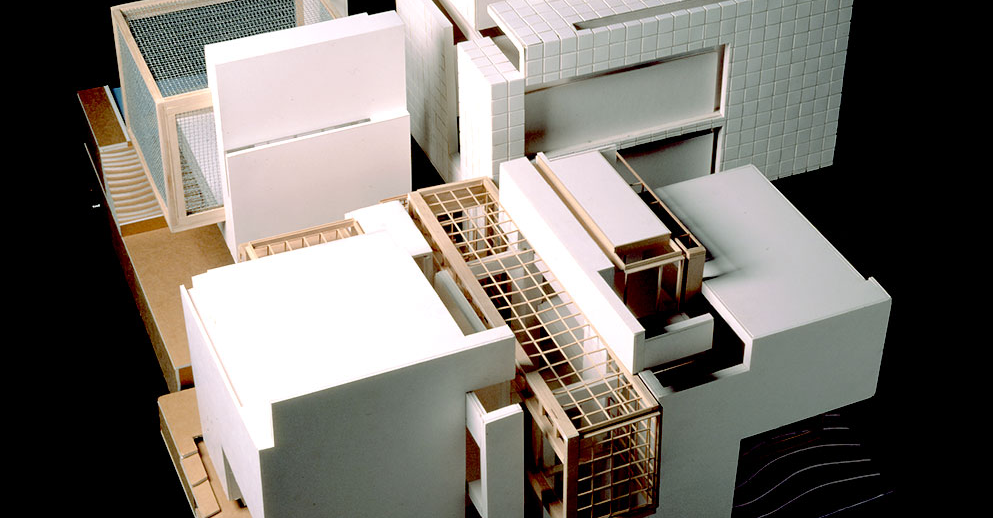
The Whites were associated with late modernism and formal abstraction, most visibly represented by the New York Five: Peter Eisenman, Michael Graves, Charles Gwathmey, John Hejduk, and Richard Meier. Their work emphasized architectural autonomy, internal formal logic, and disciplinary purity.
The Greys advanced a contrasting position. They argued that architecture could not be separated from cultural context, historical reference, or urban legibility. For them, buildings were inherently communicative and civic.
Though never formally codified, this division shaped architectural education, publishing, and professional practice for decades, and continues to inform contemporary debates about design methodology and cultural responsibility.
The Whites: Autonomy and Formal Discipline
The Whites’ position rested on the conviction that architecture should be understood primarily as an internal system of formal relationships. Meaning that, in this framework, the image emerged through geometry, structure, and spatial composition rather than through historical narrative or symbolism.
As a student, I found this position intellectually compelling. It offered rigor during a period of disciplinary instability. It suggested that architecture could preserve coherence through formal logic even when cultural consensus was fragmented.
What became clear over time, however, was that conceptual clarity alone does not guarantee institutional longevity. Architecture does not exist solely in drawings or discourse. It must persist within economic, political, and social realities.
The Greys: Context, Memory, and Public Meaning
Opposing the Whites were architects such as Robert A. M. Stern, whose work advanced a corrective rather than a rejection of modernism. The Greys argued that architecture had become disconnected from the public realm and from the cultural environments it served. Others who joined Stern and the Grey’s included Robert Venturi, Denise Scott Brown, Charles Moore, and Allan Greenberg.
For this group, architecture was fundamentally civic. Buildings participated in collective memory, urban continuity, and everyday life. Historical reference was not nostalgia but an acknowledgment of architecture’s social embeddedness.
American Postmodernism emerged from this position not as stylistic imitation, but as an effort to restore legibility, symbolism, and public engagement to architectural practice.
From Education to Practice
By the late 1980s, after founding Consulting For Architects, I encountered these theoretical divisions in a different context: professional placement. Observing firms shaped by both traditions revealed a pattern.
The Whites tended to produce influential theorists, educators, and formal innovators. The Greys more often built enduring institutions — firms capable of adapting to economic cycles and sustaining long-term client relationships.
Stern, in particular, demonstrated an acute understanding of architecture’s institutional dimension. His work suggested that ideas only endure when supported by organizational structures strong enough to carry them forward.
Acknowledging Robert A. M. Stern
With Stern’s passing, it is appropriate to recognize the scope of his influence. Beyond individual buildings, his impact extended to education, publishing, and professional leadership.
He demonstrated that architecture could maintain intellectual seriousness while remaining publicly legible. His career underscored an essential principle: architecture must not only provoke thought — it must survive time, use, and political change.
Why This Debate Still Matters
The tensions animating contemporary architecture — parametric experimentation versus human-scale design, technological efficiency versus cultural meaning, speed versus deliberation — are contemporary expressions of the same underlying conflict.
Understanding the Whites and Greys does not require allegiance to either camp. It requires recognizing that architectural progress emerges through sustained disagreement rather than consensus.
The discipline remains strongest when theory and practice remain in dialogue, when autonomy is balanced by accountability, and when architecture is permitted to operate simultaneously as formal experiment and civic instrument.
The Whites shaped how I learned to think.
The Greys shaped how architecture learned to endure.
That distinction remains as relevant today as it was in the crowded lecture halls of the 1970s.
References
Eisenman, Houses of Cards
Hejduk, Education of an Architect
Stern, Modern Classicism; New York 1900
Venturi, Complexity and Contradiction in Architecture
Moore, Body, Memory, and Architecture
Oppositions (1973–1984)
David McFadden is the Founder and CEO of Consulting For Architects Inc., a placement and project-consulting firm he founded in 1984 to align architects and interior designers with design practices on a flexible, project-based basis. Trained in architecture, McFadden worked in multiple design offices—both full-time and freelance—before identifying structural inefficiencies in traditional hiring models. His firm pioneered concepts such as flex hiring and full-time freelancing, reshaping how architectural talent is deployed across the profession. McFadden has guided clients and staff through multiple economic cycles, including four major recessions, and continues to advocate for adaptability, professional longevity, and meaningful design work within architectural practice.




No comments so far!